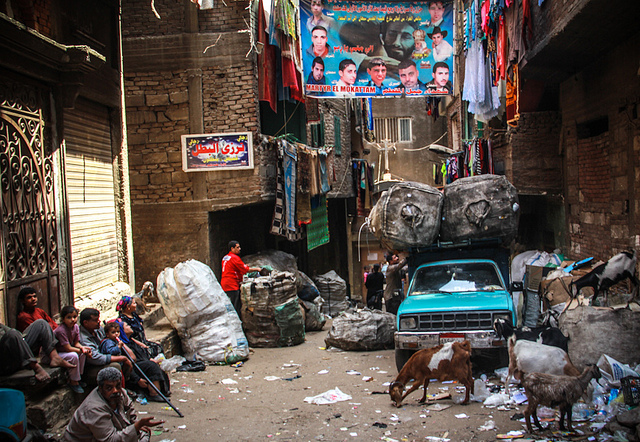
 Fuente: architectureindevelopment.org, image © MatthewCassel
Desde hace ya bastante tiempo las organizaciones no gubernamentales (ONG) han ido trabajando lado a lado con diferentes gobiernos locales y regionales en la lucha contra la pobreza y desigualdad social, es así como muchas de estas entidades han logrado brindar mejor calidad de vida a ciudadanos de los denominados asentamientos humanos informales, también conocidos bajo el nombre de SLUMS. Sin embargo, también existe mucha controversia sobre si realmente estas organizaciones son guiadas por políticas estrictamente organizacionales que buscan el bienestar común en poblaciones vulnerables, o que tal vez siguen patrones políticos y agendas de los propios donantes que financian sus actividades.
En ese sentido, se propone analizar el programa de mejoramiento urbano en la denominada “garbage city” en Egipto, tomando en cuenta investigaciones llevadas a cabo por diferentes organizaciones civiles, así como del sector privado y académico.
 Fuente: architectureindevelopment.org
Title:
NGOs empowering communities of squatter settlements through the scheme of strategic planning, in the case of the upgrading programme in Manshiet Nasser.
During the last decades, some governments denominated as rulers of the Third World have been striving to reduce and eliminated the impoverished squatter settlements or commonly known as slums (Davis, 2006). However, between the 1970 and 2000 other actors have been involved in the assignment to improve the quality of life of the dwellers belong to these informal areas. These international agencies, NGOs and grassroots organisations have worked side by side with the state in order to back financial and technical in the process to execute slum-upgrading programs (Ibid). Indeed, in that context emerge the scheme of Strategic action planning, a new concept to provide the framework to make possible cooperation among all actors over the ground in response effectively and democratically to the rapidly urbanising of slums.
Aforementioned before is related to the case of Urban Upgrading Program developed in Manshiet Nasser, located in Cairo, Egypt. At the end of the 1990s, the Egyptian government lead the initiative to mitigate squatter settlements through the improvement of urban infrastructure and empowering the communities, particularly in the more impoverished villages. The project demanded collaboration with local authorities, civil society and NGOs, of which are working twenty-five in the Manshiet Nasser area (Ahmed Soliman, 2018). In that context, these NGOs have been designated with the task to empower communities through the participatory approach. Therefore, this paper firstly will depict the framework which permits this mutual collaboration among the stakeholders, then will address the relational power between this NGO the Donor and the community, analysing some assumptions involved in the process. For instance, because NGOs dependence on donors, their agendas and political outlook are necessarily affected and even suppressed, and their links to the community will be affected. Besides, this upgrading project represents another case more, where the state influence NGO to approach informality as a barrier to set out “order.” Finally, this document will try to answer the question, if the NGO has correctly empowered grassroots organisations and communities or instead, they have persuaded them to meet objectives preestablished.
Manssheit Nasser is a lower-class settlement settled in 1960. This informal settlement was taking into account to develop The Participatory Urban Development Programme (PUMP), which was Supported, financial and technical, by the governmental institution of Germany (GTZ). The GTZ (Deutsche Gesellschaft fur Technische Zusammenarbeit) in cooperation with the government of Egypt, General Organization for Physical Planning (GOPP), proposed the PUMP as a mean to empower the communities and address the slums (Abdelhalim, 2010). Notably, they established the framework to afford cooperation among the actors, such as the local administrations, civil society, and NGOs. Indeed, the scheme employed was the Strategic Planning, in which one of the principles, is setting out synergies to develop the city-wide, making feasible the articulation among the public sector, private sector and civil society (Albrechts, Healey & Kunzmann, 2003). Moreover, this scheme is capable of using a no-rigid methodology, namely, permits adjustments and improvements over the process, and afford a space to practice good governance (Ibid). Likewise, McCarney (1996) pointed out that good governance grants democratic decisions, enabling the opportunity to avoid bureaucratic decisions, and instead permits to restructure the power relations over the stakeholders, performing it more equal for all. In that sense, the PUMP leading by the GTZ and GOPP, and implemented on the ground by the 25 NGOs, operated beneath the mutual accountability, since each entity required to establish actions and responsibilities that they had to perform over the communities and also between each other. Accordingly, to Eyben (2008), mutual accountability is perceived as multiple sets of dyadic relationships among beneficiary and the donor, in which both have to be accountable to their respective authorities, dwellers and between them.
Likewise, and stated by the World Bank in the report, entitled Governance: the way how power is performing among the state and civil society to develop a country is related to the practice of governance. Therefore, Strategic Planning, which creates a platform to develop PUMP in Manshier Nasser also permit to establish a framework to makes feasible explore what constitutes relational power linked with good governance (Albrechts & Balducci, 2013). Indeed, as pointed out by McCarney (1996), the essential characteristic of governance is the concept to be accountable, when the actions are performing establishing a democratic mean over the process of tackling urban poverty. Hence, good governance implies mutual accountability among the actors to afford managing equal power relations. Consequently, in theory, strategic planning gives the tools to perform mutual accountability and perform equal power relations among the actors in the process of good governance.
As a matter of fact, PUMP aims toward stimulating the cooperation of all involved parties, especially the 25 NGOs existing in the area, as a tool to achieve sustainable urban development (Abdelhalim, 2010). The framework of the programme allows working side by side with the communities to address an area, which is suffering from poor living conditions, depleted of essential services, lack of urban infrastructure, and deteriorating environmental conditions (Ibid). Hence, PUMP set out overall goals, such as implement participatory planning, build capacity development and empowerment of gender. Consequently, the twenty-five existing NGOs working in the project have been placed collectively in order to work as a branch of the programme, namely they have been assigned to operate other interests of the plan, e.g. women empowerment, environmental awareness, youth productivity and strengthening skills of dwellers to work and live into their communities(Ibid). According to the report of GTZ, the performance of NGOs on the ground showed positive results on different levels. First of all, on the micro level, they were able to set out self-help among the residents, specifically NGOs empowered people with skills of being capable of solving their problems; besides, it has also improved the relationship between inhabitants of squatter settlements with the local governments. On the middle level, local governments have been set out participatory programmes in order to deliver essential services and attending priorities among the dwellers. Finally, on the macro level, over the time the upgrading programme has become a priority policy taking into account by the national government and replicated in other cities along Egypt, operating in all the cases a participatory planning process (Hegazy, 2015).
Therefore, at this stage, is understood that the labour of NGOs was linked to empowering dwellers to implement the programme designed by GTZ and GOPP, this over the impoverished communities in the frame of participatory planning. Establishing a mutual accountability and equal power relation. However, in the arena of lacking financial resources and high rates of poverty both donors and national governments seeks for NGOs in order to set out plans over the cities in a directly and cheaply way (Marcussen, 1996). Indeed, many NGOs noticed the importance of its role over the ground to attract the international funding and national attention; this reality led many NGOs to be an accountable whit the Donors and governments that they depend, operating within the communities whit objectives and plan preestablished, rather than start a consultative process (Ibid). Furthermore, setting a contract among NGOs, governments and Donors, power is understood as a resource that donors intend to have more of (Ibid). In that sense, the work of NGOs operating in Manshiet Nasser as a branch of the GOPP and GTZ reflects that communities have been trained to respond objectives determined early.
Consequently, communities obtained during the process a condition of receptors in the power relations, as Foucault depict, power it is not necessarily a matter of individuals, instead it reflects the positions they occupy (Cornwall and Gaventa, 2006). Hence, communities occupied a position to receive and to satisfy what the project set out before, instead of making efforts to work in decision-making to design the PUMP. At the same time, The NGOs operated procedures related to the PUMP, designed by the Donor and government, setting out a position of a mean to meet goals determined by the higher entity.
Regarding those statements above, exist diverse participatory planning approaches, which depends basically on how to address issues into the communities. Notably, the World Bank within the Upgrading Urban community distinguished four different, one of them carried out by GTZ, the ZOPP (or GOPP in English: Goal Oriented Project Planning) (Noureddine Tag-Eldeen, 2003). Indeed, the performance of ZOPP, according to Hamdi and Goethert (1997), lack of efficiency when it uses methods to empower communities, due to ZOPP works through objectives preestablished, such this approach does not contribute to strengthening the community itself (Ibid). In other words, ZOPP methodology operates selecting representatives among the participants namely, individuals that represent the interests of others. Most of them, technical staff and high-level authorities, since they have all of the knowledge of how to set out the project. As a result, GTZ worked with high standards of technicality in order to develop workshops to implement the goals of the programme. This approach does not permit the community as an organisation capable of leading or planning its programs; instead, they always will depend on external organisations. Consequently, the ZOPP methodology is profoundly dependent on a high-grade external input; therefore, the community cannot develop either its unique participatory projects or manage those (Hamdi & Goethert, 1997). In that scenario, the condition and position of the community members are determined as a low-qualified, placed into the low level of the hierarchy, when relational power is acting.
Likewise, considering Cornwall and Gaventa (2006), exists three forms of power, the visible, hidden and invisible, and are recognisable when they are interacting in the participatory process. For instance, each of these types of power shapes the relationships among the actors, in which knowledge is performing as a way of power. Thus, knowledge is a resource which defines decision making, becoming it a visible way of power (Ibid). In that sense, the ZOOP methodology practices the visible power when places the staff, responsible to implement the project, as a high-qualified knowledgeable, and the communities as a low-qualified organisation. Afterwards, the hidden power which is related to the action of the production of knowledge is capable of shaping the political agenda(Ibid), thus the NGOs are performing the hidden power as well, since they have been empowering the individuals into the communities, but no strengthening the community itself to permits them produce knowledge to prepare their plans(Ibid). In that sense, the participation process whit unchangeable power relations will only contribute to see the process as more democratic but not changing the status quo. Besides, Chambers argues, specialists during the process of participatory process produce and reproduce hierarchies of knowledge linked whit power directly, in fact, they are establishing a position of more qualified than others, the character who will train and teach (Eyben, 2008). Thus, power widely will be understood as a relationship of dominations in which the control of knowledge makes a set of differences in social relations (Ibid). Therefore, it is clear that the relational power placed in the last position the community members of Manshiet Nasser since they lacked the technical expertise to address their issues, in this manner they were only following the plan specified before.
On the other hand, according to the project team responsible of the PUMP pinpoint that the participation planning carried out by the NGOs involved women and young people in upgrading project, thus was expected that both roles would be strengthening in order to make a change in their daily life (Hegazy, 2015). In consequence, the project was striving to remove the old preconceptions between men and women in the development process to guarantee and promote sustainable urban upgrading (Ibid).
At that point, and according to Eyben (2008), mutual accountability could be seen different if the view of relational of power is understood as a process instead of resource, namely if the notion of power related to principal holder is displaced by the notion of power as dispersed along the community, this power could operate in all relationships. Thus, power recognised as a capability can enable to the social change, in other words, when the power does not attribute to specific entities, the approach changes to reciprocal responsibility to help others to work in changing their social limits and empower their selves. Hence, the NGOs working beneath the umbrella of PUMP designed by GTZ and GOPP showed the power as a resource, since they were responsible for meeting first the purposes determined before by the Donor and the State.
Following aforementioned before, according to the research carried out by the team operating the upgrading plan, The NGOs were operating in Manshiet Nasser with a not accurate definition of the community nature due to the PUMP previously authenticated a homogeneous identity of the households (Noureddine Tag-Eldeen, 2003). Thus, it does not necessarily expose homogeneity over the condition of socio- economic status. In other words, and according to Hamdi & Goethert (1997), The accurate recognition and understanding of the type of a particular community provide the knowledge to undertake accurately tools to operate on the ground. Indeed, over the area of Manshiet Nasser, there are the low, middle-income groups running their workshops, as well as, investors that have their business activities inside the area (Ahmed Soliman, 2018). It reflects various types of residents with diverse matters, expectations and conflicts. Consequently, and mentioned before in this paper the methodology using in this participatory process of empowering communities (ZOPP), lacks to understand the complexity of community as a whole, instead only has identified the necessities and characteristics among the individuals (Ibid). That means that NGOs have been following the conditions and preconceptions rooted in the PUMP by the Donor and government.
Overall, the NGOs performed a role taking the initiative of empowering communities following the programme towards improving the national upgrading policy, addressing informal settlements based on the experience and lessons learnt by GTZ in small- scale upgrading projects in other parts of Egypt. The GTZ approach efforts on participatory process-oriented and poverty-oriented. The PUMP set out a field of dialogue, between the beneficiaries, local communities, and the decision makers authorities (Noureddine Tag-Eldeen, 2003). Therefore, NGOs have played a role as an arm of the GTZ, giving the opportunities to the dwellers, to at least be consulted in the process of taking actions over the upgrading programme. This approach could be another case where the residents were persuaded to meet the policies and the vision of the authorities to address slums.
Moreover, according to the project team, the involvement of the residents is one of the primary means to execute the upgrading plan. The results were reached by recognising all actors as mutual equivalent (Hegazy, 2015). Indeed, NGOs over the process of participation has followed some directions assigned by GTZ. First, the community is urged to participate in the plan, yet it is not clear if that meant that they were taking part in decisions or instead that they were only being informed. Also, it has existed concerns among the participants to being persuaded to validating professional measures (Ibid).
To sum up, the framework where the NGOs where able to work was established by the strategic planning and showed in the PUMP, since it opened the space to permit a process of dialogue among the actors. Hence the scheme meets principles such as reinforcing synergies, consulting and informed the procedures among the communities, then creates a relationship based on respect and trust between the state, the international agencies and the civil society, aiming for good governance. However, the power of the donor and government have not passed through into the communities instead of that the power of knowledge remained presented on the GTZ and NGOs over the process. In a broader sense, it arguably that mutual accountability should not remain as a particular concept and relation between governments and donors, it should be transparent and embrace a more extensive set of stakeholders, aiming to perform power as a capacity to empower grassroots organisations and local institutions (Eyben, 2008). Finally, NGOs assistance has been seeing as a supplement to complement, when international governmental institutions work with other governments on the scheme of multilateral aid. In other words, the actions and roles taken by the NGOs lastly have been more as implementors of projects, using participatory methods (Marcussen, 1996), due to NGOs are perceived by the governments and Donors as organizations capable to work directly whit the recipients of the projects, reaching the poor and reinforcing the links with the state (Ibid). In that scenario, exists the hypothesis that strengthening civil society through NGOs, will give a positive outlook of the state since the NGOs are filling some critical functional gaps in service not offered by the government before, but working on behalf them (Ibid). Moreover, it will provide the state with the resource to retain power and control over the communities, and even consolidating its legitimacy. Therefore, according to the case carried out in Manshiet Nasser, the power was remaining by the Donor, and it used the NGOs to perform the project preestablished.
Bibliography.
Albrechts, L. & Balducci, A., 2013. Practicing Strategic Planning: In Search of Critical Features to Explain the Strategic Character of Plans. disP – The Planning Review, 49(3), pp.16–27.
Ahmed Soliman, M. (2018). Towards Strategic Planning Implementation for Egyptian Cities.The International Journal of Environmental Science & Sustainable
Development, 2(1), pp.1-13.
Abdelhalim, K. (2010). Participatory Development Programme in Urban Areas | GIZ Egypt. [online] Egypt-urban.net. Available at: http://www.egypt-urban.net/ [Accessed 02 Apr. 2019].
Albrechts, L., Healey, P. & Kunzmann, K.R., 2003. Strategic Spatial Planning and
Regional Governance in Europe. Journal of the American Planning Association, 69(2), pp.113–129.
Davis, M., 2006. Planet of slums /Mike Davis., London: Verso.
Gaventa, J. & Cornwall, A., 2006. Challenging the Boundaries of the Possible: Participation, Knowledge and Power. IDS Bulletin, 37(6), pp.122–128.
Eyben, R. (2008). Power, Mutual Accountability and Responsibility in the Practice of International Aid: A Relational Approach. [online] Ids.ac.uk. Available at: http://www.ids.ac.uk/files/Wp305.pdf [Accessed 01 Apr. 2019].
Hegazy, I. (2015). Informal settlement upgrading policies in Egypt: towards improvement in the upgrading process. Journal of Urbanism: International Research on Placemaking and Urban Sustainability, 9(3), pp.254-275.
practice /Nabeel Hamdi and Reinhard Goethert., Chichester: John Wiley.
 urbanalab.org
Deja un comentario